
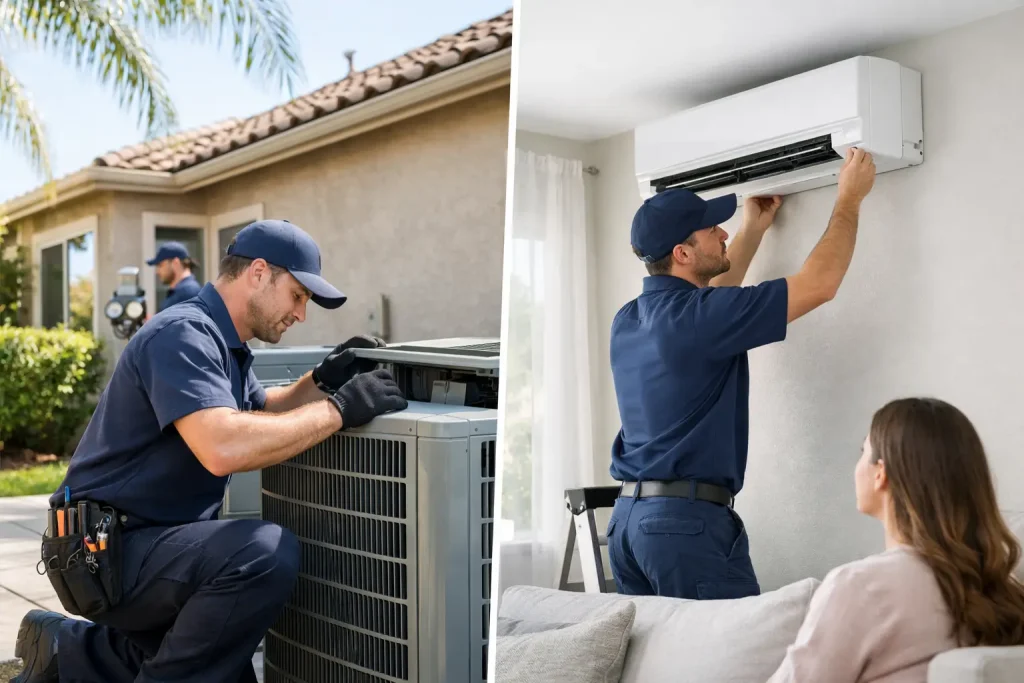
A cooling system should do more than lower the thermostat reading. It should keep bedrooms comfortable, handle Modesto summer heat, fit the layout of the property, and run without creating unnecessary energy waste. When comparing central air vs ductless, the best choice usually comes down to your existing ductwork, the rooms that need cooling, and how you use the space every day.
Central air remains a strong option for whole-home comfort. Ductless systems can be an efficient answer for additions, older homes, problem rooms, and targeted comfort needs. Neither system is automatically better in every situation. A careful evaluation helps prevent a replacement decision that looks good on paper but falls short during the hottest part of the year.
Central Air vs Ductless: The Basic Difference
A central air conditioning system cools air at one outdoor unit and sends it through a network of ducts to rooms throughout the home or business. In many properties, the system shares ductwork and an indoor blower with the heating equipment. One thermostat often controls the entire building, although zoning options may be available.
A ductless mini-split system uses an outdoor unit connected to one or more indoor air handlers. Each indoor unit serves a specific room or zone and has its own temperature control. Instead of using large ducts, the system needs a small opening through an exterior wall for refrigerant lines and wiring.
That difference affects everything from installation planning to comfort control. Central air is designed around whole-property distribution. Ductless is designed around room-by-room flexibility.
When Central Air Is the Better Fit
For a home with sound, properly sized ductwork already in place, central air is often the most straightforward solution. It can deliver consistent cooling to every room without adding wall-mounted air handlers. Many homeowners prefer the clean appearance of vents and a single thermostat, especially in larger homes with a traditional layout.
Central air also makes sense when you want to replace an aging AC unit while keeping a compatible forced-air furnace. The existing equipment, ductwork, and electrical setup may allow for a more efficient replacement with less disruption than a full system redesign.
The critical phrase is properly sized ductwork. Leaky, poorly insulated, undersized, or badly designed ducts can undermine a new high-efficiency air conditioner. Some rooms may stay warm while others become too cold, and the equipment may run longer than it should. Before choosing central air, have a qualified technician inspect the full system, not just the outdoor unit.
Central air can be especially practical for property managers and small business owners who need consistent comfort across an entire building. A well-designed system can simplify operation and maintenance when the goal is uniform cooling in common areas, offices, or multiple rooms with similar schedules.
When Ductless Makes More Sense
Ductless cooling is often the right answer when extending or repairing ductwork would be difficult, disruptive, or inefficient. Homes built without ducts, converted garages, additions, workshops, and enclosed patios are common examples. A ductless unit can provide dependable cooling in the new space without forcing the existing central system to work beyond its intended capacity.
It is also useful for rooms with persistent temperature problems. A second-story bedroom that stays hot, a sun-facing office, or a room over the garage may need more than a thermostat adjustment. A dedicated ductless unit gives that room its own cooling source and its own control.
Zoning is one of the biggest advantages. Instead of conditioning unused rooms all day, occupants can set temperatures based on where people are actually spending time. This can be helpful in households with different comfort preferences or commercial spaces with varying occupancy.
Ductless systems do require a visible indoor unit in each zone. Some homeowners like the compact design, while others prefer the less noticeable look of central vents. Proper placement matters, too. An indoor unit must be positioned to distribute air effectively without blowing directly onto a bed, desk, or seating area.
Comfort and Energy Use Depend on the Design
It is easy to assume that ductless is always more efficient because it does not use ducts. Duct losses can be significant, particularly when ducts run through hot attics. However, system efficiency depends on more than the equipment label. Correct sizing, installation quality, insulation, thermostat settings, maintenance, and the home’s overall condition all matter.
A ductless system can reduce wasted cooling by serving only occupied zones. But installing too many indoor units, running every zone constantly, or selecting the wrong capacity can reduce the expected savings. A central system with sealed ducts, balanced airflow, and appropriate equipment sizing can also perform very efficiently.
The same principle applies to comfort. Oversized equipment may cool a room quickly but shut off before removing enough humidity. Undersized equipment can run constantly and struggle during peak heat. In the Central Valley, where summer temperatures can put real strain on cooling equipment, accurate load calculations are more valuable than a quick guess based on square footage alone.
Installation Considerations for Your Property
Central air installation is generally less invasive when the duct system is already in good condition. If a property needs entirely new ducts, the project may involve access through attics, crawl spaces, ceilings, or walls. The scope depends on the building’s age, design, and accessibility.
Ductless installation usually avoids extensive duct construction, but it still requires careful planning. The outdoor unit needs a suitable location with adequate clearance and service access. Indoor units need properly routed line sets, condensate drainage, and secure mounting. The electrical capacity must also support the equipment.
For either option, the installer should assess more than the old unit’s size. Window exposure, ceiling height, insulation, room use, occupancy, and existing airflow all influence the right recommendation. Replacing equipment with the same capacity simply because it was installed before can repeat an old comfort problem.
Maintenance Is Different, Not Optional
Central air maintenance includes changing filters regularly, keeping supply and return vents open and clear, and scheduling professional service to inspect refrigerant performance, electrical components, the condenser, and airflow. Ductwork may also need attention if there are leaks, debris concerns, or uneven temperatures.
Ductless systems need their filters cleaned regularly because each indoor unit handles air in its assigned zone. Indoor coils, blower components, drain lines, and the outdoor unit also need professional attention. Neglecting these tasks can lead to reduced airflow, odors, water leaks, and declining efficiency.
In either system, unusual sounds, weak airflow, warm air, short cycling, water around equipment, or sudden increases in utility use are reasons to schedule service promptly. Waiting through a heat wave can turn a manageable issue into an urgent breakdown.
Questions That Lead to the Right Choice
Start with the condition of your current ductwork. If it is efficient and reaches every area of the property well, central air may offer the best value and the simplest whole-home experience. If ducts are missing, inaccessible, or unable to serve a problem area, ductless may be the more practical path.
Next, consider how the building is used. A family that wants even cooling throughout the house may prefer central air. A homeowner with an addition or a frequently used home office may benefit from a ductless zone. For rental properties and small businesses, the decision may hinge on room schedules, tenant control, and whether cooling needs vary significantly from one area to another.
Finally, think beyond the initial installation. The right system should be serviceable, appropriately sized, and realistic for the property’s long-term needs. A certified HVAC technician can evaluate the layout, inspect existing equipment, and explain the trade-offs without pushing a one-size-fits-all answer.
For homeowners and businesses in Modesto, YourK AC can help assess whether central air, ductless cooling, or a combined approach makes the most sense for the space. The goal is not to install the trendiest option. It is to restore dependable comfort with a system that fits the way your property actually works.
Comments are closed.