
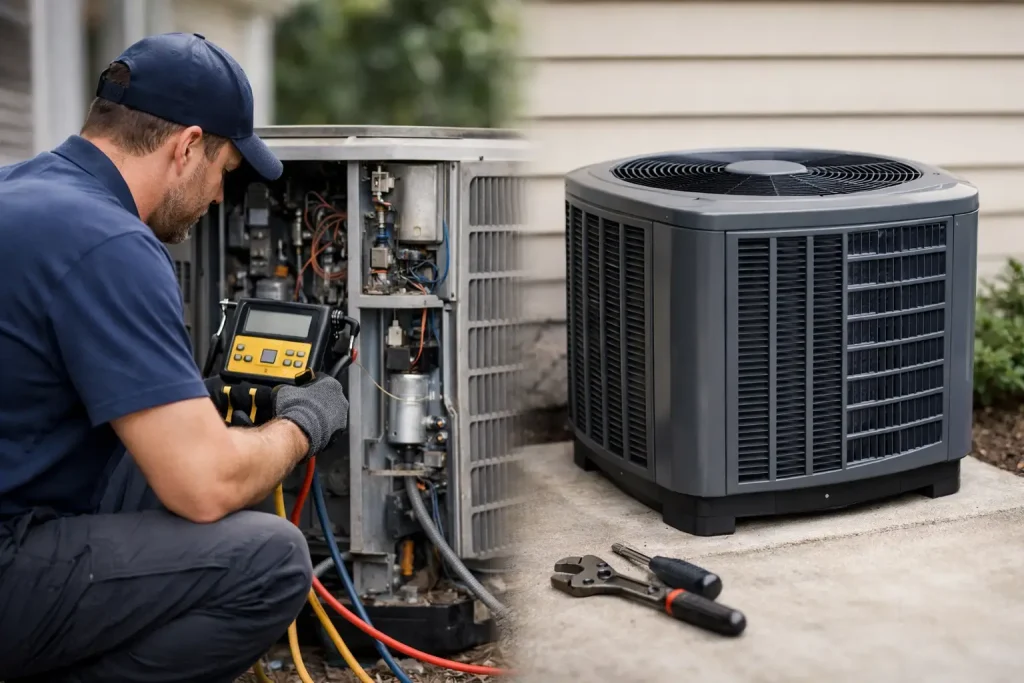
When your AC quits during a Modesto heat wave, the question is not theoretical. You need cold air back fast, and you need to know whether putting money into a fix is smart or whether it is time to move on. That is why ac repair vs replacement is one of the most common decisions property owners face, especially when the system is older, repair costs keep stacking up, or the unit cannot keep up anymore.
This is not always a simple yes or no call. Some air conditioners have a clear, affordable fix and can keep running reliably for years. Others are sending warning signs that every repair is just buying a little more time at a higher long-term cost. The right answer depends on the age of the system, the type of problem, the repair history, your energy bills, and how dependable you need that equipment to be.
AC repair vs replacement starts with the age of the system
Age matters because air conditioners have a practical service life. Many central AC systems last around 10 to 15 years with proper maintenance, but that range can shrink when units work hard through long summers, miss regular tune-ups, or have major components wearing out.
If your system is under 10 years old and the issue is isolated, repair usually makes sense. A failed capacitor, contactor, thermostat, or fan motor can often be fixed without turning the job into a major investment. If the unit has otherwise been reliable, a targeted repair is often the most cost-effective move.
Once a system gets closer to 12 to 15 years old, the equation changes. Older equipment is more likely to break again, less likely to run efficiently, and may use outdated refrigerant. At that stage, even a successful repair may not solve the bigger problem, which is that the system is simply near the end of its useful life.
For commercial spaces and rental properties, age carries even more weight. Downtime affects tenants, employees, customers, and operations. If an aging unit is already causing service disruptions, replacement may protect you from repeat emergency calls when you need cooling the most.
When repair is usually the right call
Repair tends to be the better option when the problem is clear, the cost is reasonable, and the rest of the system is in solid shape. That is especially true if the AC still cools well, your utility bills have stayed fairly steady, and this is the first meaningful repair in years.
A newer system with one failed part should not automatically be replaced. In many cases, a professional repair restores full performance quickly. If the compressor is healthy, airflow is good, and the system has not been leaking refrigerant repeatedly, repairing the issue is often the practical choice.
You should also lean toward repair if the unit is still properly sized for the home or building. If your comfort problems are tied to a worn component rather than a bad installation or undersized equipment, fixing the current system can be a smart use of money.
The same is true when timing matters. If you need immediate relief and the unit can be repaired safely and affordably, there is value in getting your home or business comfortable again without the delay and expense of a full replacement.
When replacement makes more sense
Replacement becomes the stronger option when repairs are expensive, frequent, or only partly solving the issue. If you are calling for service every summer, the system is telling you something. At a certain point, repeated repair bills stop being the cheaper route.
A common rule of thumb is to compare the repair cost to the age and condition of the system. If a major repair on an older unit is going to cost a large percentage of what a new system would, replacement is often the better investment. That is not just about avoiding one more repair. It is about avoiding the next one too.
Replacement also makes sense when comfort has become inconsistent. If some rooms stay hot, the AC runs constantly, humidity feels high indoors, or the system struggles every afternoon, the problem may be bigger than a single broken part. A new, properly matched system can improve comfort, lower strain on the equipment, and reduce energy use.
Then there is the utility bill factor. Older units usually need more electricity to deliver less cooling. If your summer bills keep rising and usage habits have not changed much, an aging AC may be costing you more every month than you realize.
The real cost question is bigger than the repair bill
A lot of property owners compare one repair estimate against one replacement estimate and stop there. That is understandable, but it can lead to the wrong decision. The better question is what this system is likely to cost you over the next few years.
A cheaper repair can still be the more expensive path if it is followed by another breakdown in two months, another refrigerant issue next season, and poor efficiency the whole time. On the other hand, replacement has a higher upfront price, so it has to be justified by better reliability, lower operating costs, and a realistic expectation that the old unit will keep causing trouble.
This is where honest assessment matters. You do not want to replace a repairable system too early. You also do not want to keep funding an air conditioner that is no longer dependable. A trustworthy technician should be able to explain both options clearly, including what they would do if it were their own property.
Repair vs replacement for major components
Some AC issues are routine. Others are turning points.
If the problem is a clogged drain line, faulty thermostat, weak capacitor, or worn contactor, repair is usually straightforward. These are common service calls and often do not justify replacing the entire system.
If the compressor has failed, the evaporator coil is leaking badly, or the condenser has multiple aging parts wearing out at once, replacement deserves serious consideration. Those are expensive repairs, and on an older system they often signal that more issues are coming.
Refrigerant type can also affect the decision. Older systems that use phased-out refrigerants can become much more expensive to repair when leaks happen. Even if the unit can be fixed, future service may remain costly. In that situation, replacement may offer better long-term value.
AC repair vs replacement for homeowners who plan to stay
If you plan to stay in your home for years, replacement can be easier to justify because you are more likely to benefit from improved efficiency, better comfort, and fewer breakdowns. You are not just solving today’s problem. You are reducing future stress during the hottest months of the year.
That said, not every long-term homeowner needs a new system right away. If your current AC is still relatively young and the repair is minor, there is no reason to replace it early just because new equipment exists. The goal is not to spend more. The goal is to spend wisely.
For homeowners getting ready to sell, the decision can go either way. A reliable repair may be enough if the system is working well again and the property is going on the market soon. But if the AC is visibly old, noisy, and unreliable, replacement can remove a buyer objection and make the home easier to show during hot weather.
What property managers and small business owners should weigh
For rental properties and commercial spaces, reliability often matters more than squeezing every last month out of old equipment. Tenant complaints, business interruptions, and emergency service calls have real costs, even if they do not appear on the repair invoice.
If an AC unit serves a retail shop, office, or occupied rental and keeps failing under load, replacement may be the more stable business decision. Predictable cooling is easier to budget for than repeat downtime, especially in peak summer.
Property owners also need to think about reputation. A business that feels hot inside loses customer comfort. A rental with ongoing AC problems creates frustration fast. Choosing replacement before repeated failures pile up can save money and protect relationships.
Get a decision based on condition, not pressure
The best ac repair vs replacement decision comes from a full inspection, not a guess. A technician should look at the system’s age, repair history, airflow, refrigerant condition, electrical components, and overall performance before recommending the next step.
That kind of evaluation protects you in both directions. It helps you avoid replacing a unit that still has good life left, and it helps you avoid throwing more money at a system that is already on its way out. At YourK AC, that practical approach matters because most customers are not looking for a sales pitch. They want a straight answer, fast service, and a solution they can trust when the temperature rises.
If your AC has stopped keeping up, the smartest next step is not choosing repair or replacement on your own. It is getting a clear diagnosis from a local HVAC team that will tell you what makes sense for your property, your budget, and the way you actually use the space. A good decision today should still feel like the right one when the next heat wave hits.
Comments are closed.