
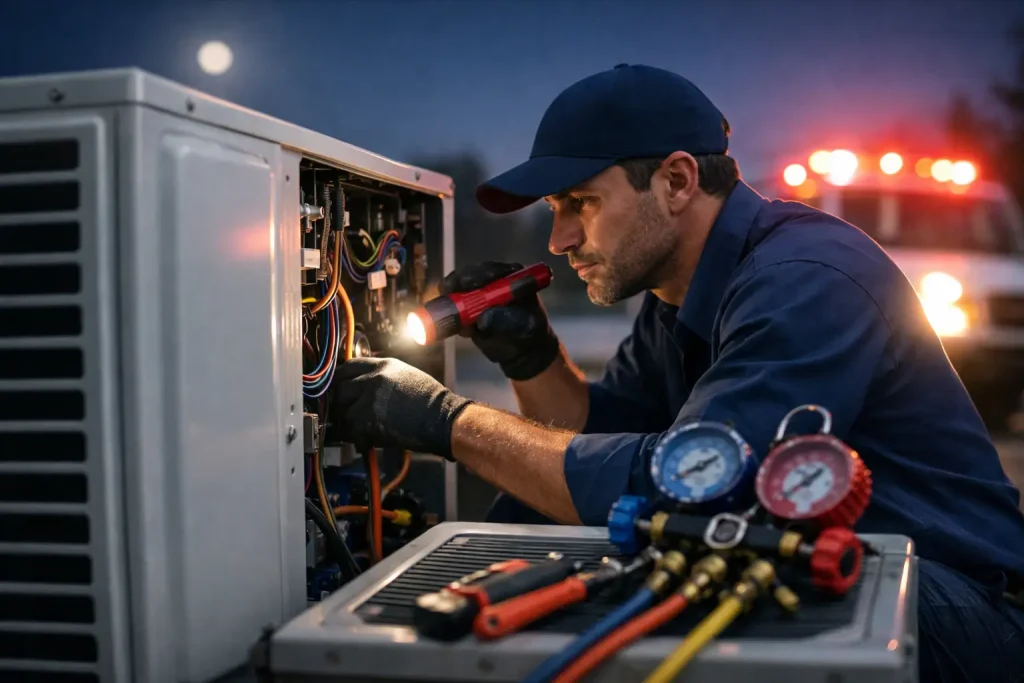
When your AC quits at 10 p.m. in the middle of a Modesto heat wave, this is not a problem you plan around. It is a get-it-fixed-now situation. That is exactly why 24 hour emergency air conditioner repair matters for homeowners, property managers, and small business owners who cannot afford to wait until regular business hours.
A broken air conditioner is more than an inconvenience when indoor temperatures keep climbing. Bedrooms become hard to sleep in, tenants start calling, customers leave early, and heat-sensitive equipment can be put at risk. In some homes, especially those with young children, older adults, or anyone with medical concerns, a cooling failure can become urgent very quickly.
When 24 hour emergency air conditioner repair is the right call
Not every AC issue needs a middle-of-the-night dispatch, but some absolutely do. If your system has stopped blowing cold air and the house is getting hotter by the hour, waiting can make the situation worse. The same goes for units that will not turn on at all, systems tripping the breaker repeatedly, burning smells, loud grinding or banging noises, or signs of water leaking where it should not be.
Commercial spaces have another layer of urgency. Restaurants, offices, retail shops, and small facilities often need stable indoor temperatures to stay operational and keep staff and customers comfortable. A failed system during business hours costs money. A failed system overnight can turn into a rough start the next morning if no one acts fast.
There is also a practical side to emergency service that people sometimes overlook. A struggling system can put stress on other components while it keeps trying to run. What starts as a capacitor issue or electrical fault can grow into a larger repair if the unit is left cycling, overheating, or shorting out.
What happens during an emergency AC repair visit
The biggest concern most people have is simple. How fast can someone get here, and can they actually fix it tonight?
A true emergency service call should focus on speed, clear communication, and getting your cooling back with as little disruption as possible. That starts with asking the right questions on the phone so the technician arrives prepared. You should expect a direct explanation of what to check safely before the visit, an honest timeframe, and a technician who is ready to diagnose the problem instead of guessing.
Once on site, the first step is usually confirming whether the issue is electrical, mechanical, airflow-related, or tied to the thermostat or controls. Many no-cool calls come down to failed capacitors, contactors, motors, clogged drain protection switches, frozen evaporator coils, dirty filters, or refrigerant-related problems. Some are straightforward. Others require a closer look because the symptom you notice is not always the root cause.
That is where experience matters. A rushed repair that only treats the symptom can leave you calling again in a day or two. A dependable technician should explain what failed, what can be fixed now, and whether there are any signs of a bigger issue that needs attention soon.
Why fast response matters in Modesto heat
Summer in the Central Valley does not give you much room for delay. When outdoor temperatures spike, indoor heat builds fast, especially in older homes, upper-floor units, and commercial spaces with glass frontage or heavy occupancy. Even a few hours without cooling can make a property uncomfortable. Overnight, the problem often feels worse because people expect temperatures to drop enough to recover, and sometimes they do not.
Fast service is not only about comfort. It can protect indoor air quality, prevent moisture problems from poor airflow or drain issues, and reduce the chance of additional stress on the system. Property managers know this well. A quick response can prevent one maintenance problem from turning into multiple complaints.
For business owners, the stakes are equally real. If employees are distracted, customers are uncomfortable, or inventory conditions are affected, downtime has a direct cost. Emergency service helps contain that disruption before it spreads into the next day.
What you can do before the technician arrives
If you need 24 hour emergency air conditioner repair, there are still a few safe checks that may help narrow things down. Start with the thermostat. Make sure it is set to cool, the temperature is below room temperature, and the batteries are not dead if your model uses them.
Next, check the air filter. A severely clogged filter can contribute to freezing, weak airflow, and shutdowns. If the system has ice on the indoor coil or refrigerant line, turn the unit off and switch the fan to on if possible. That can help it thaw before service. If a breaker has tripped once, you can reset it one time. If it trips again, stop there. Repeated resets can point to an electrical problem that needs professional attention.
Also look for water around the indoor unit. A clogged condensate drain can trigger a safety shutoff in many systems. If you notice a burning smell, buzzing from electrical components, or any sign of overheating, shut the system down and wait for the technician.
These steps are not a replacement for repair, but they can help prevent extra damage and give the service team better information when they arrive.
What sets good emergency service apart
When people call after hours, they are usually stressed, overheated, and worried about cost. The best emergency HVAC service does not make that worse. It keeps the process straightforward.
That means honest pricing, clear communication, and no pressure to approve more work than the situation requires. Sometimes the right move is a targeted repair that gets the system running again. Sometimes the technician will find that the unit is near the end of its life and repeated repairs no longer make financial sense. Both situations happen. What matters is getting a clear recommendation based on the condition of the system, not a sales pitch.
It also helps when the company knows the local area and common cooling demands. In Modesto and nearby communities, AC systems work hard for long stretches. That affects wear patterns, refrigerant performance, capacitor failure rates, and how quickly comfort drops when a system goes down. Local experience shortens the learning curve.
A company like YourK AC is built around that reality. Fast response, practical troubleshooting, and dependable follow-through matter more in an emergency than flashy promises.
Repair now or replace soon?
This is one of the most common questions during an emergency call, and the answer depends on timing, cost, and the age of the system. If your AC is relatively new and the issue is isolated, repair is often the clear choice. You want the fastest path back to normal, and a solid repair usually provides it.
If the system is older, uses outdated refrigerant, or has had multiple breakdowns in recent seasons, the conversation changes. Emergency repair may still be the best short-term move, especially at night or during a heat spike, but it may not be the smartest long-term plan. In those cases, many property owners choose to restore operation first and schedule a replacement estimate once the immediate crisis is over.
That is the balanced approach. You solve the urgent comfort problem now and make a calm decision about the bigger investment afterward.
How to reduce the odds of another after-hours breakdown
No maintenance plan can promise that an AC will never fail at a bad time. Parts wear out. Electrical components fail unexpectedly. Extreme weather pushes systems harder than usual. Still, regular service lowers the odds of a sudden shutdown and helps catch issues before they become emergencies.
A tuned system runs cleaner, drains properly, cycles more efficiently, and gives technicians a chance to spot weak components early. That matters for both homes and commercial properties. Preventive maintenance is almost always less stressful and less expensive than emergency repair, even though emergency service remains essential when timing is not on your side.
The simplest habit that makes a difference is changing filters on time. After that, seasonal inspections, coil cleaning, refrigerant checks, and electrical testing all help reduce surprise failures when you need cooling most.
When your air conditioner stops working after hours, the right move is not to wait and hope it fixes itself. It is to get a qualified local technician involved quickly, ask direct questions, and focus on the fastest safe path back to reliable cooling.