
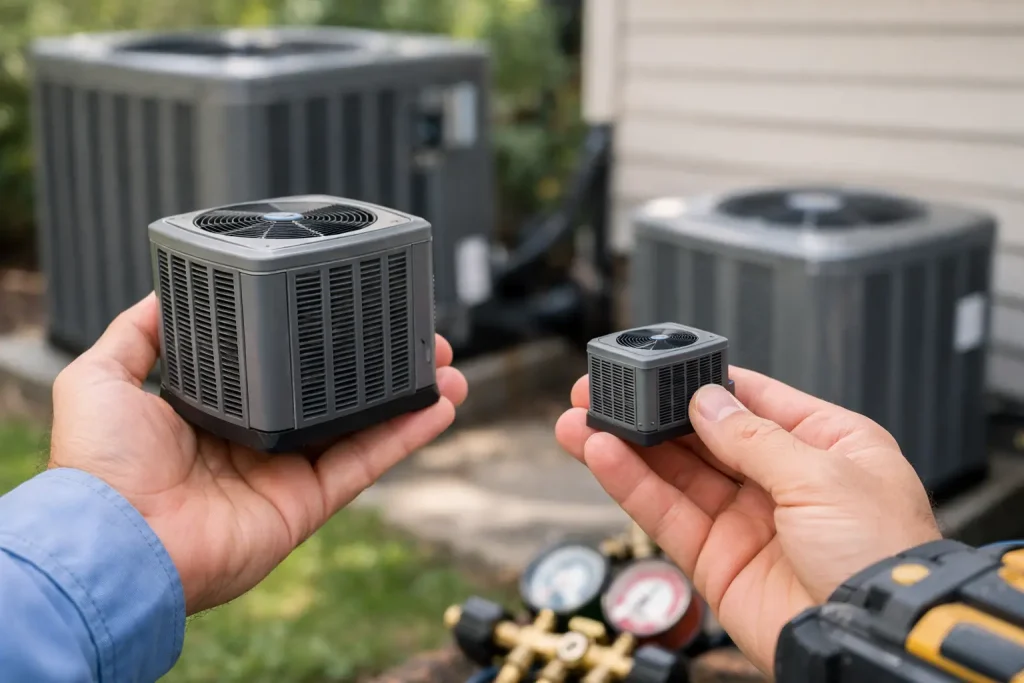
If your house never quite cools down, or your AC turns on and off all day without making the place comfortable, sizing may be the real problem. A lot of homeowners ask, what size ac unit do i need, expecting a quick square-foot answer. The honest answer is more specific than that, because the right size depends on your home, your layout, and how hard your system has to work in Modesto heat.
An air conditioner that is too small will struggle through hot afternoons, run longer, and wear down faster. One that is too large can cool the house too quickly, shut off before removing enough humidity, and create uneven temperatures from room to room. Bigger is not automatically better, and smaller is not always cheaper once high energy bills and repeat repairs start showing up.
What size AC unit do I need for my home?
Most AC systems are sized in tons, not weight, but cooling capacity. One ton equals 12,000 BTUs of cooling per hour. Many homes fall somewhere between 2 and 5 tons, but that range is broad enough that guessing can get expensive.
As a rough starting point, many people use square footage. A smaller home might need around 1.5 to 2.5 tons, while a larger home may need 3 to 5 tons or more. But square footage alone leaves out key details. Two homes with the same size can need very different AC capacities if one gets full afternoon sun, has older windows, or has poor insulation in the attic.
That is why rule-of-thumb charts should be treated as starting points, not final answers. They can point you in the right direction, but they should not be the reason you approve a full system installation.
Why square footage alone is not enough
The biggest sizing mistakes usually happen when someone looks only at the home’s total area and skips everything else. In real-world HVAC work, the system has to match the heat load of the property, not just the floor plan.
Ceiling height matters because more air volume takes more cooling. Window size and orientation matter because west-facing windows can add a lot of heat in the afternoon. Insulation matters because a well-sealed home holds conditioned air better than an older drafty one. Occupancy matters too. A home with several people, cooking activity, and heat-producing electronics will place more demand on the AC than a quieter household.
Your ductwork also plays a role. Even the right-sized unit can underperform if ducts leak, are undersized, or do a poor job distributing air. In those cases, homeowners sometimes think they need a larger unit when the actual problem is airflow.
Common AC size ranges by home size
If you want a general idea before scheduling an estimate, these ranges can help frame the conversation. A home around 1,000 square feet may need roughly 1.5 to 2 tons. A home around 1,500 square feet may land closer to 2 to 3 tons. A 2,000 square foot home often falls in the 3 to 3.5 ton range, while 2,500 square feet may need 3.5 to 4 tons.
Still, these are only estimates. A shaded, energy-efficient home may need less than expected. An older home in full sun with weak insulation may need more. Commercial spaces are even less predictable because occupancy, equipment loads, and operating hours change the calculation.
That is why a trustworthy HVAC contractor will not give a firm answer from square footage alone, especially for replacement jobs where comfort issues may already exist.
What affects AC sizing in Modesto
Modesto summers are not mild. Long stretches of high temperatures put serious demand on residential and light commercial cooling systems. That local climate matters because an AC unit must be sized for peak conditions, not just average spring weather.
Homes in this area also vary widely. Some have newer windows and better insulation. Others were built years ago and lose cool air faster than owners realize. Sun exposure is another factor. A house with little tree cover and large sun-facing windows may need more cooling support than a similar house a few streets over.
If you are replacing an older system, it is also worth questioning whether the previous unit was correctly sized in the first place. Plenty of homeowners assume they should install the same tonnage again, but if the old system short cycled, struggled constantly, or left hot spots around the home, repeating that size may repeat the same problem.
Signs your current AC may be the wrong size
Sizing problems often show up as comfort complaints first. If your AC runs constantly and still cannot keep up on hot days, it may be undersized. If it blasts cold air, shuts off quickly, and starts again soon after, it may be oversized.
Other warning signs include uneven room temperatures, unusually high energy bills, excess indoor humidity, and frequent service calls. Short cycling is especially hard on components because the system starts and stops more often than it should. Over time, that can mean more wear on motors, capacitors, and compressors.
These symptoms do not always point to sizing alone. Dirty coils, low refrigerant, poor maintenance, and duct leaks can create similar issues. That is why proper diagnosis matters before deciding on replacement.
The best way to find the right size AC unit
The most reliable method is a professional load calculation, often called a Manual J calculation. This process looks at the actual cooling needs of the property instead of relying on rough averages. It factors in square footage, insulation levels, window types, ceiling heights, air leakage, sun exposure, and more.
This takes more effort than a quick guess, but it leads to better performance and fewer surprises. When an HVAC technician sizes a system correctly, you are more likely to get steady temperatures, lower operating costs, and longer equipment life.
For business owners and property managers, this step matters just as much. An undersized system can frustrate tenants or customers. An oversized one can waste money month after month. Either way, poor sizing becomes a comfort and budget issue.
Should I size up just to be safe?
This is one of the most common questions, and usually the answer is no. Homeowners often think going a little larger gives them extra protection during extreme heat. In practice, oversizing can create a different set of problems.
An oversized unit cools the air so fast that it may not run long enough to remove enough moisture or distribute air evenly through the house. That can leave the home feeling clammy, especially in certain rooms, while increasing wear from constant cycling. You pay for more capacity without necessarily getting better comfort.
There are situations where system design changes the conversation. For example, zoning, variable-speed equipment, duct upgrades, or major home additions may affect what size makes sense. But those are design decisions that should be based on measurements and load calculations, not guesswork.
When replacement is the right move
Sometimes homeowners start by asking what size ac unit do i need when the bigger question is whether the current system should be repaired or replaced. If your AC is older, needs frequent repairs, or struggles every summer, replacement may be the more cost-effective path.
A new properly sized system can improve comfort and efficiency at the same time, especially if the old unit was mismatched to the home. It also gives you a chance to evaluate the full setup, including thermostat performance, duct condition, and airflow. That full-picture approach is often where the best results come from.
If you are not sure where your system stands, a professional inspection can help separate a repair issue from a sizing issue. That keeps you from spending money in the wrong place.
Get the answer based on your property, not a guess
Online charts can be helpful, but they cannot see your insulation, your ductwork, your window exposure, or how your building handles afternoon heat. If you want an AC that cools reliably without driving up operating costs, the right size should be based on the property itself.
For homeowners and business owners in Modesto, that means working with a local HVAC team that understands the climate and takes the time to size the system correctly. YourK AC approaches AC installation the practical way – by looking at how the space actually performs, not by pushing a one-size-fits-all answer.
The right unit should keep you comfortable on the hottest days, run the way it should, and give you confidence that your money went toward a real solution, not a guess.